The second edition of The Andalusi Legacy in l’Horta Sud arrives
It will take place on Saturday, 29 November at the Museu Comarcal de l’Horta Sud and will feature the participation of Antonio Manuel Rodríguez
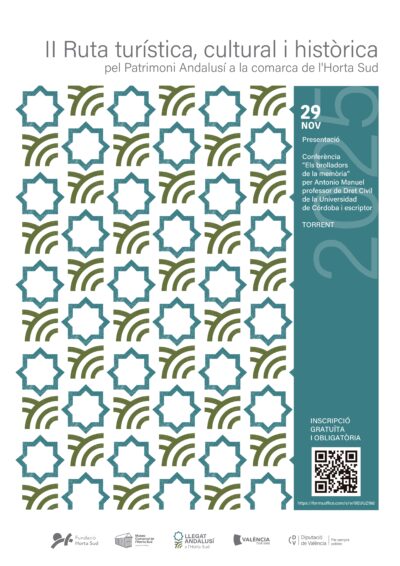
The 2nd Tourist, Cultural and Historical Route through the Andalusi Heritage of the Horta Sud region will offer a journey into the roots and Andalusi legacy of our territory.
25 November 2025 — Just over a year ago, on 19 October 2024, the professor, writer and expert on Andalusi culture, Antonio Manuel Rodríguez, inaugurated, during an event held at the Museu Comarcal de l’Horta Sud, the first edition of the Tourist, Cultural and Historical Route through the Andalusi Heritage of the region. That day, a total of four routes were launched, covering the Museu Comarcal and the Andalusi Tower in Torrent, the Moorish Tower of Albal, the Espioca Tower in Picassent and, finally, the tower and Archaeological Museum of Silla. However, due to the DANA storm, only the first two routes — in Torrent and Albal — could be carried out.
Now, thirteen months after that first day, the 2nd Tourist, Cultural and Historical Route through the Andalusi Heritage is taking place. It will begin this Saturday, as in the previous edition, at the Museu Comarcal de l’Horta Sud with the lecture “The Springs of Memory”, delivered by Antonio Manuel Rodríguez. The lecture is open to the public but with limited seating, requiring prior registration.
The Andalusi legacy of l’Horta Sud
The Andalusi period developed in the Iberian Peninsula under the Caliphate of Córdoba from its origins until its fragmentation into taifa kingdoms. The Valencian territory was divided into three independent kingdoms: the Taifa of Alpuente, the Taifa of Valencia and the Taifa of Dénia.
With the arrival of Jaume I and the conquest of Valencia, these kingdoms disappeared and gave way to the creation of the Christian Kingdom of Valencia. The land transitioned from being a family-run agricultural unit organised into small rural communities (alquerías) to a feudal system. The fact that the Aragonese monarch respected the customs of the indigenous Andalusi population meant that this culture remained alive in our lands until the expulsion of the Moriscos in 1609—lasting 400 years longer in Valencia than in the rest of Spain.
A significant number of towns in the Horta Sud region preserve in good condition the defensive towers that, during the Middle Ages, served to protect and monitor the city and the agricultural lands of Valencia.
But the Andalusi legacy goes far beyond the towers. The alquerías, the irrigation channels, the toponymy of the landscape and the remaining farmland are an important part of the history of Valencian men and women. Understanding the origins of a unique irrigation system, and being able to value the material and immaterial culture that remains alive today — to transmit it and offer it as a tourist attraction — can become yet another economic pillar in a region that has been fundamental to the development of the city of Valencia.
About Antonio Manuel Rodríguez
Other news of interest
Join the ‘Salvem las Fotos’ volunteer initiative to help preserve the collective memory and heritage of l’Horta Sur
[…]