Why the associative movement is important and how to strengthen it
September 24, 2025 – We are very clear that the associative movement is essential to build a more supportive, democratic, fair, equal and prosperous society. This is evidenced by the fact that many of the rights we consider inherent today were not implemented until a few decades ago, always driven by collective action.
In a crisis like the DANA, the key contribution of local associations has once again been demonstrated as spaces for meeting, support and solidarity. Without this work, recovery would be much slower, more complex and lonelier. Because rebuilding is not only about raising what is material again, but also about healing the emotional and community fabric. Resilience is born from mutual support and from the network built among organizations.
Therefore, it is essential that organizations fully assume our role and be clear about our basic functions. Functions that are linked to community cohesion, resource generation, the promotion of participation and the empowerment of citizens.
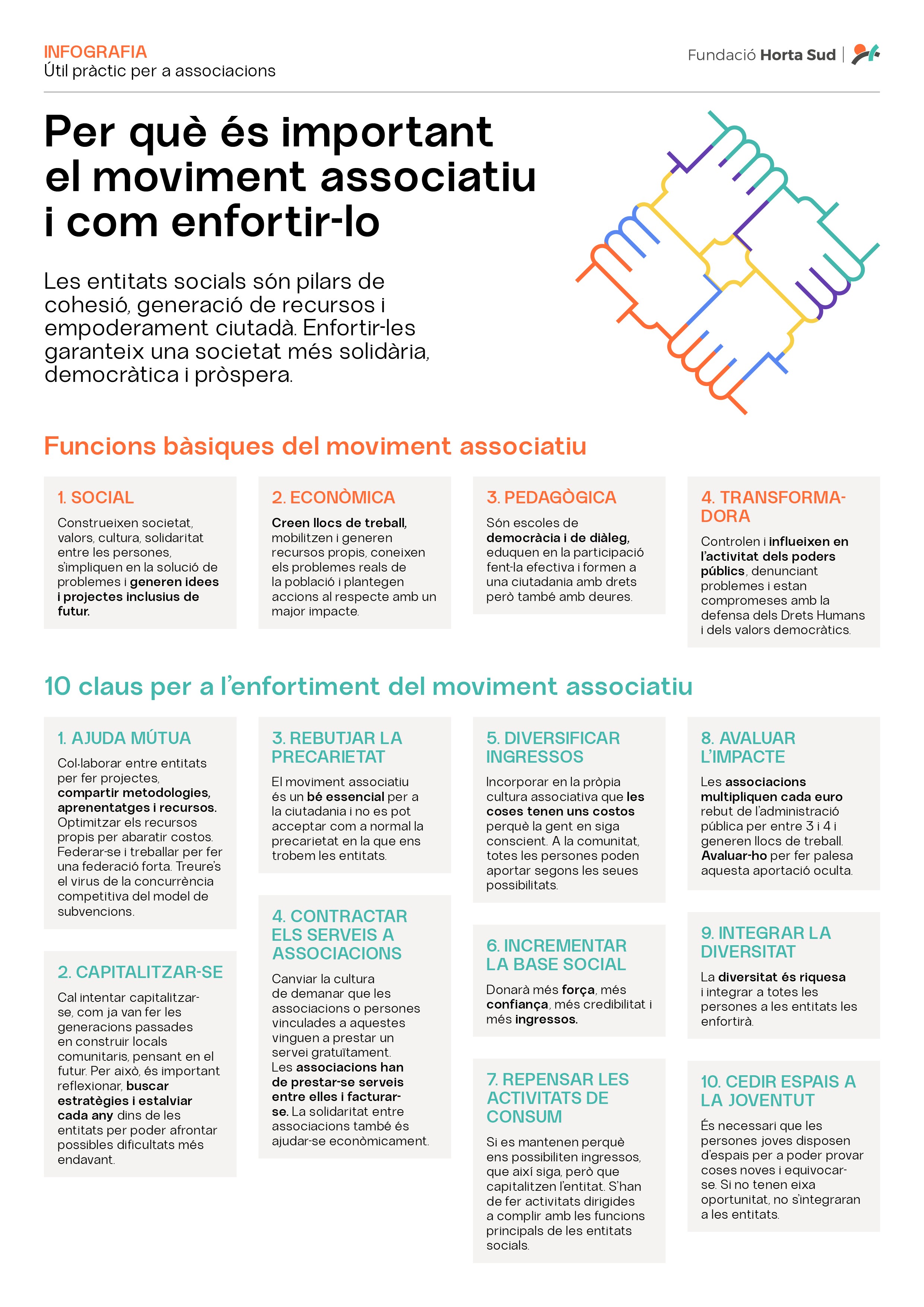
4 basic functions
- Social function, as spaces of collective life where values are built and solidarity is fostered. In associations, relationships of trust are woven and support is offered in times of difficulty. Community is generated, bonds are created and social cohesion in neighborhoods and towns is strengthened.
- Economic function, mobilizing resources and creating jobs, often in areas where the administration does not reach. By knowing first-hand the real needs of citizens and, with few resources, it is possible to multiply their impact. Every public euro invested in associations multiplies its value threefold or even fourfold, returning to society a wealth that goes far beyond the economic.
- Educational function, acting as true schools of democracy. In them people learn to participate, to dialogue and to assume responsibilities. Those who pass through the association discover that, in addition to rights, we have duties as citizens. This formative experience creates people who are more committed, more critical and more aware of the common good.
- Transformative function, acting not only within your community, but also influencing the public sphere. Denouncing injustices, proposing solutions and defending human rights and democratic values. Being the voice of organized citizenship and playing a key counterweight role to public powers, ensuring more transparency and greater social justice.
Therefore, it is essential that organizations fully assume our role and be clear about our basic functions. Functions that are linked to community cohesion, resource generation, the promotion of participation and the empowerment of citizens.
10 keys to strengthen the associative fabric
To put all this into practice and become aware of our real value, we have prepared a guide with 10 keys to strengthen the associative fabric.
Among the proposals, we highlight the need to collaborate between organizations, share resources and work in a federated way to overcome competitive logic. We also stress the importance of building capital and diversifying income, embracing the idea that every activity has a cost and that everyone can contribute according to their possibilities.
We assert that we cannot accept precariousness as a habitual condition. That is why we argue that associations should contract services among ourselves and recognize financially the work we do. In addition, it is essential to increase the membership base, embrace diversity and evaluate the real impact we have: every public euro invested in associations multiplies its value three or four times.
Organizations must also rethink consumption activities, giving space to young people so they can experiment and make the associative project their own. Only in this way will we guarantee generational renewal and the continuity of our transformative role.
We encourage you to download this resource, discuss it in your organizations and become aware of the importance of strengthening the associative fabric. The future depends on not normalizing precariousness and on equipping ourselves with more resources and confidence to face future challenges such as the climate emergency or housing. Only by strengthening ourselves as a community will we be able to build a fairer, more resilient and collective future.
Other news of interest

Join the ‘Salvem las Fotos’ volunteer initiative to help preserve the collective memory and heritage of l’Horta Sur
[…]